
• Skip to main content
  • Skip to primary navigation
  • GotSport Onboarding
  • DONATE
Eastern NY Youth Soccer Association

Eastern NY Youth Soccer Association

  • About
    • About ENYYSA
    • Meet the Officers
    • Zero Tolerance Policy
    • Rules & Bylaws
    • Our Affiliates
    • ENY Hall of Fame
    • Sponsorships & Advertising
    • Contact Us
  • Programs
    • TOPSoccer
    • Trainers
      • List of Verified Trainers
    • College Scholarships
    • Futsal
    • Referees
  • Safe Soccer
    • ENYYSA Safe Soccer
    • SafeSport Training
    • Heads Up – Concussion Awareness
    • Background Checks
      • Alternate Background Checks
    • Safer Sports Tools
    • COVID-19
  • ODP
    • What is ODP?
    • Tryouts 2025/26
    • Tryout Results
    • ODP Schedule
    • ODP Coaching Staff
    • Regional/National Pool Selections
    • ODP International Tour
    • ODP Scholarship
    • ODP Contacts
  • Competitions
    • ENY State Cup
    • Sanctioned Tournaments
    • Member Leagues
    • USYS National League
  • Coaching
    • Coaching Overview
    • Grassroots License
      • Grassroots Mandate
    • Available Coaching Courses
    • Instructional Staff
    • US Soccer Learning Center
  • Resources
    • Documents & Forms
    • Insurance Summary
    • Indoor Facilities Insurance
    • Travel Authorization
    • Out Of State Player Registration
    • USYS Award Nomination – The Ball
    • Gender Identity
    • USYS Diversity, Equality and Inclusion
    • Employment Opportunities
    • GotSport Onboarding
    • DONATE
SECOND TOP LOGO (THE ONE ON THE RIGHT)

Coaching Education

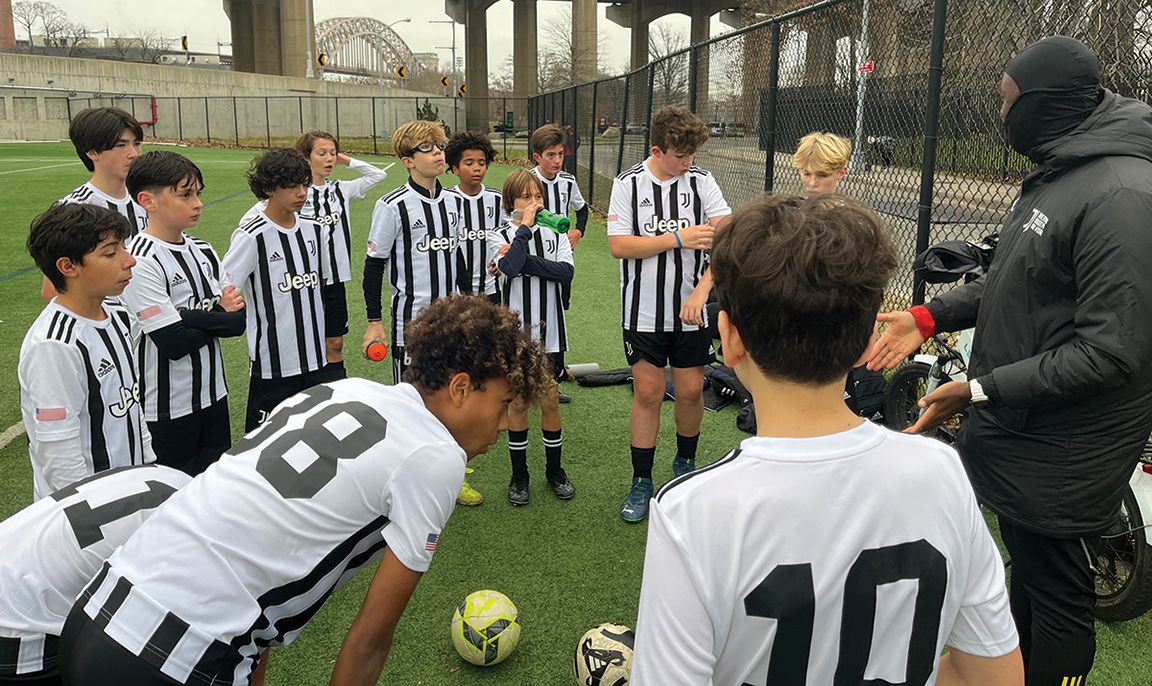
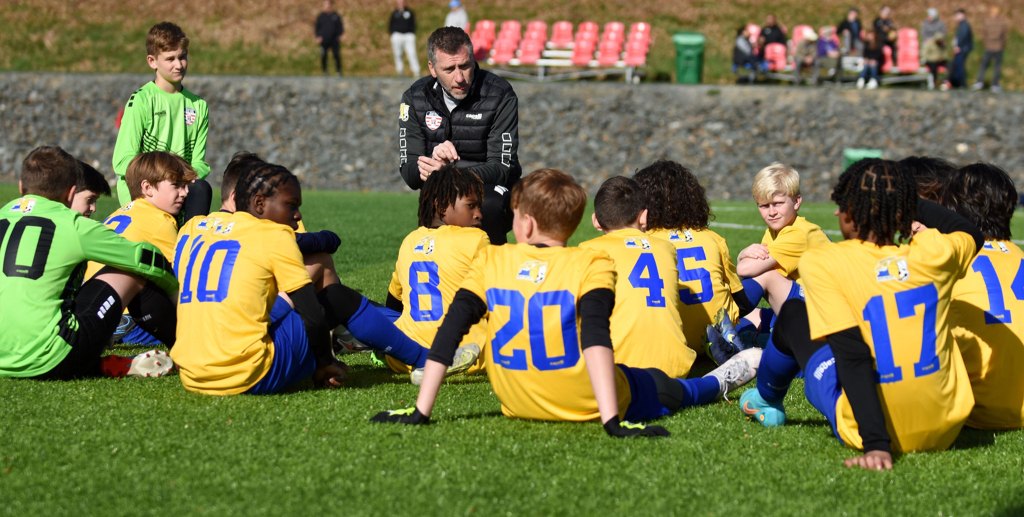
Halftime Talks That Scramble Their Brains

By Tim Bradbury, Director of Coaching, Eastern New York Youth Soccer Association

Having spent more than 30 years coaching and educating coaches in both formal and informal environments, I can honestly say I’ve witnessed many highlights — and many lowlights. I wish that the clips playing through my mind had evolved and that we were making new mistakes in how we teach youth players. Unfortunately, one area of persistent concern remains: the half-time talk.

I’m not entirely sure why this happens. Perhaps it’s the emotion of the game, the inability of some coaches to remember what effective teaching and learning look like, or simply a lack of emotional control. Whatever the reason, the result is almost always the same.

You’d have to look long and hard to find a half-time talk that isn’t one (or more) of the following:

1. Overloaded with information: So many points and observations that players remember none of them.

2. Confusingly structured: Players leave more confused than when they came in.

3. Emotionally-charged: Full of anger or frustration, robbing players of the joy of the second half.

4. Mentally-draining: Too many words and too much noise, leaving players unable to think or problem-solve.

5. Command-driven: Filled with orders that shut down creativity and independent thinking.

6. One-way communication: Offering players no opportunity to discuss their own thoughts (even though they’re the ones playing).

7. Undermined by parents: Followed by contradictory instructions shouted from the sidelines.

8. Contradictory among adults: With multiple coaches or helpers desperate to make a point, talking over one another without listening.


To bring some clarity and purpose to the half-time pantomime, I urge coaches to try the following process:

  • Observe and record key statistics throughout the first half, focusing on elements connected to your team’s style of play.
  • Use substitutes to help track simple data. For example: consecutive passes, times we switched the point of attack, number of overloads created, passes that broke lines, and players joining the attack.
  • Apply the “Rule of Three plus One.” Limit yourself to three clear and concise team points, supported by simple statistics.
    Example: “We need to work harder to support the player on the ball so we can build attacks. Our longest passing sequence was only three, we can do better.” (These key points should be previewed in your pregame talk so players know what to expect.)
  • Plus One: After the three team points, give each player one simple technical focus.
    Example: “Tim, work on taking your first touch away from pressure.” (These should also connect to the goals discussed before the game.)
  • Start the halftime talk with the players. Have them discuss what went well and what challenges they faced, ideally within their team units. and let them report back before you speak.
  • Check in individually to provide feedback on each player’s pregame goal.
  • Make it a habit for players to speak first and last. After all, it’s their team and their game.

The Long Island Junior Soccer League Helps Launch the Young Coaches Alliance

By Randy Vogt, Director of Public Relations, Eastern New York Youth Soccer Association 

October 29, 2025-The Long Island Junior Soccer League (LIJSL), the largest league in the Eastern New York Youth Soccer Association (ENYYSA), has announced a new coaching initiative. Named the Young Coaches Alliance, the LIJSL is partnering with the American Soccer Club NY (ASCNY) and The Coaching Manual in serving coaches ages 18-30 who want to begin or further their development in coaching.

“I’m excited and proud to roll out this coach-centric program for young coaches in our area,” said John Fitzgerald, LIJSL Sporting Director and ASCNY Head Coach. “The collaborative commitment from the three organizations behind this project forms a solid foundation for the Young Coaches Alliance to be successful. We’ve been able to join coaching education, professional experiences, and coaching support, so that up-and-coming young coaches can have a positive and supportive start to their coaching journeys. This is a worthwhile venture that will solidly benefit the game.”

The goal is to provide a positive start for young coaching careers. The program offers several benefits including coaching education, experiential learning, access to a coaching app with training sessions and season plans plus mentoring. Some of the benefits are listed below:

• One tuition-free grassroots coaching education course

• Hands-on experiential learning with professional team

• Attend ASCNY training sessions

• Invitation to one free ASCNY home match, with total access

• Observe college training sessions

• Lessons on creating/structuring/preparing training sessions

• Three months free subscription to The Coaching Manual

• Mentorship

“American Soccer Club NY – ‘Fighting Tomcats,’ are proud to stand alongside the LIJSL and The Coaching Manual in shaping the next generation of coaches,” ASCNY General Manager Jim Kilmeade explained. “Through our soon-to-be-launched Sideline Club, we’re committed to creating pathways that not only elevate the game but also empower young leaders on Long Island who will carry the spirit of the sport forward. This initiative reflects our belief that investing in coaches is investing in the future of our players, our clubs, and our communities.”

“We’re proud to support this program,” said Terry Barton, CEO of The Coaching Manual. “At our core, we’ve always believed in the incredible coaching talent across the USA, and we’ve spent years helping it thrive. This initiative perfectly blends local delivery with a global mindset, giving young coaches the tools and knowledge to elevate the game and inspire the next generation of soccer talent.”

Application deadline: January 15, 2026 (candidates must be 18 years or older as of March 1, 2026)

The selection committee will pick 10 candidates for the program and you can apply here. 

With over 100,000 youth soccer players––both boys and girls––and more than 25,000 volunteers, the non-profit Eastern New York Youth Soccer Association (ENYYSA) stretches from Montauk Point, Long Island to the Canadian border. Members are affiliated with 10 leagues throughout the association, which covers the entire state of New York east of Route 81. ENYYSA exists to promote and enhance the game of soccer for children and teenagers between the ages of 5 and 19 years old, and to encourage the healthy development of youth players, coaches, referees and administrators. All levels of soccer are offered––from intramural, travel team and premier players as well as Children With Special Needs. No child who wants to play soccer is turned away. ENYYSA is a proud member of the United States Soccer Federation and US Youth Soccer. For more information, please log on to http://www.enysoccer.com/

John Fitzgerald to Receive the Mike Berticelli Excellence in Coaching Education Award

By Randy Vogt, Director of Public Relations, Eastern New York Youth Soccer Association 

October 22, 2025-United Soccer Coaches has announced the selection of John Fitzgerald as the 2025 Mike Berticelli Excellence in Coaching Education Award recipient for his outstanding contributions to coaching education and his singular service to the game.

Fitzgerald becomes the 26th person to receive prestigious recognition from his peers. The award is named in honor of Mike Berticelli, the Association’s former Vice President of Education and men’s coach at the University of Notre Dame who passed away in 2000.

Fitzgerald is Sporting Director and Director of Coaching Education for the Long Island Junior Soccer League (LIJSL), the largest league in the Eastern New York Youth Soccer Association (ENYYSA).

“This is a fitting recognition for someone whom has a profound effect on Coaching Education and the development of coaching standards across Long Island,” stated LIJSL President Andrew Seabury.  “There are not many coaches who coach in the LIJSL, both past and present, who have not benefitted from John’s influence and passion for the highest coaching education standards. This high honor is well deserved.”

Fitzgerald’s extensive experience and dedication to soccer make him a prominent figure in the coaching community, particularly on Long Island where he continues to influence the development of young players and the growth of the sport.

The Smithtown resident is a highly respected coach with over 35 years of experience spanning professional, collegiate and youth soccer. He is currently the head coach of the American Soccer Club New York, a newly established team competing in the National Premier Soccer League (NPSL). Fitzgerald brings an impressive depth of knowledge and a proven record of achievement to this position, having earned recognition throughout the New York soccer community.

“John embodies what the Berticelli Award is about and is truly deserving of this honor for his passion and dedication to coaching education,” United Soccer Coaches President Paul Payne explained.

John Fitzgerald coaching in Eastern New York’s Olympic Development Program.

Fitzgerald’s coaching journey includes several notable roles:

• Associate Head Coach, U.S. Merchant Marine Academy: In this role, Fitzgerald contributed to the team’s six NCAA Division 3 tournament appearances, helping the program achieve a strong reputation and consistent performance.

• Director of Coaching, New York Cosmos: Fitzgerald was responsible for overseeing training and player development programs. He also served as assistant coach for Cosmos B, who captured the 2015 NPSL national championship.

• Head Coach, Long Island Lady Rough Riders: Under his leadership, the Lady Rough Riders won a national championship in the W-League, further establishing his credentials.

• Longtime coach in Eastern New York’s Olympic Development Program (ODP), including Boys Director of Coaching.

• Current head coach of East Region ODP Boys 2009 team.

Fitzgerald has been recognized for his outstanding contributions to coaching. He was named the 2004 NSCAA/Adidas Northeast Regional Assistant Coach of the Year and the 1997 Newsday Coach of the Year, as well as head coach of that years’ Umbro W-League All-Star select team His involvement in coaching education includes serving as the NSCAA State Director for Long Island and as a National Staff Instructor as well as a US Soccer coach educator.  Fitzgerald’s teams have accumulated significant successes, including a record of 228-100-20 at the U.S. Merchant Marine Academy as well as multiple conference championships and NCAA tournament appearances. 

The Berticelli Award will be presented at the association’s Awards Ceremony on Friday, January 16, 2026, in conjunction with the 86th Annual United Soccer Coaches Convention in Philadelphia.

With over 100,000 youth soccer players––both boys and girls––and more than 25,000 volunteers, the non-profit Eastern New York Youth Soccer Association (ENYYSA) stretches from Montauk Point, Long Island to the Canadian border. Members are affiliated with 10 leagues throughout the association, which covers the entire state of New York east of Route 81. ENYYSA exists to promote and enhance the game of soccer for children and teenagers between the ages of 5 and 19 years old, and to encourage the healthy development of youth players, coaches, referees and administrators. All levels of soccer are offered––from intramural, travel team and premier players as well as Children With Special Needs. No child who wants to play soccer is turned away. ENYYSA is a proud member of the United States Soccer Federation and US Youth Soccer. For more information, please log on to http://www.enysoccer.com/

No Drills, No Way, Ever!

By Tim Bradbury, Director of Coaching, Eastern New York Youth Soccer Association

Maybe it’s because I played the game as a kid and hated every drill I was put through. Maybe it’s because I can still remember the boredom as another repetitive exercise drained all the joy from soccer as quickly as a cold drink disappears on a hot day. Or maybe it’s because I was a creative kid who loved solving problems in my own way, and drills offered nothing but rote learning, with someone telling me exactly what to do and when to do it.

Whatever the reason, my dislike for drills runs deep.

That dislike only grew stronger when I studied Physical Education at university in England. Everything I learned about teaching methods, learning theory, and effective practice reinforced what I already knew: drills were joyless, restrictive, and ineffective. I felt validated — and inspired to create training activities that gave players freedom to think, solve problems, and have fun.

And the evidence keeps piling up. Every research article, every seminar on learning environments, every training course only strengthens the case against drills.

Which is why it’s so frustrating to see so many youth coaches still leaning on them. Time and again, I watch players slog through endless drills, their body language shouting the same message: I’m bored. I’m disengaged. I’ll make my own fun if the coach won’t. Ironically, it’s often these same coaches who then ask for advice on discipline or complain that their players lack focus.

And don’t get me started on pre-game warmups. How can a string of lifeless drills — with zero connection to the actual game — possibly prepare players to compete with energy, creativity, and intensity?

It’s time to stop. For good.

Here are the Top 10 Reasons Never to Use Drills:

  1. Drills are zero fun.
  2. Soccer is all about decisions and drills shut down thinking.
  3. Drills are boring.
  4. True skill development (myelination) depends on thinking, not repetition without thought.
  5. Drills create robots, not problem-solvers.
  6. Quality training looks like a slice of the game but drills never do.
  7. Drills push players away from the sport.
  8. The game demands decisions under pressure and drills don’t replicate this.
  9. Drills involve standing around waiting, guaranteed to be a fun killer.
  10. There are simply better, more engaging ways to teach.

What to Do Instead

  • Design activities that look and feel like real soccer.
  • Let players think, make mistakes, and find solutions.
  • Are competitive, challenging, and fun.
  • Can be structured to repeat key skills under increasing pressure.
  • Keep everyone involved at all times.
  • Force players to juggle multiple problems at once, just like the demands in the game.

Do this, and your players will show up to practice with energy, passion, and joy. They’ll learn more, improve faster, and fall in love with the game — the way it’s meant to be played.

The Art of Coaching Games

By Tim Bradbury, Director of Coaching, Eastern New York Youth Soccer Association

Coaching games in youth sports is one of the most demanding and delicate tasks a coach will face in creating a positive and development-focused game day environment. I’ve seen intelligent, player-centered coaches who are calm and supportive during training, transform into sideline drill sergeants when the whistle blows. Game day brings out emotions, pressure and competing priorities, which can often derail the focus on development and enjoyment.

Why Game Day Is So Demanding

The Pressure to Win: The “every game is a World Cup final” syndrome is real. Instead of focusing on player growth and fun, many coaches and parents feel immense pressure to chase results, often at the expense of learning.

Overzealous Parents: Many parents prioritize joining “winning programs” over development-focused environments. They sometimes forget that soccer is a team sport, and every child needs meaningful playing time to grow.

Parents as Extra Coaches: Sideline instructions from well-meaning parents can overload young players, making independent decision-making nearly impossible.

Coaches’ Ego: Some coaches feel defined by their win-loss record. The “I am only as good as my next win” mindset can drive decisions that prioritize short-term results over long-term development.

Transactional vs. Transformational Cultures: Does your team’s game-day environment encourage fun, learning, and resilience? Or does losing feel like Armageddon? The tone set by coaches and parents directly shapes the players’ experience.

Decision-Making Overload: Soccer already requires rapid decision-making under pressure. When coaches and parents add hundreds of extra commands, they unintentionally drown players’ ability to think independently on the field.

Best Practices for Coaches and Parents on Game Day

Before the Game

  • Players arrive 45 minutes before kickoff for a player-led, game-like warm-up.
  • Coaches deliver short, clear team talks with a maximum of three key objectives.
  • Each player gets one “Glow” (strength) and one “Grow” (area of focus).
  • Coaches meet briefly with parents to explain the day’s objectives.
  • Players write expectations for parents on a visible board.
  • Defenders, midfielders, and forwards huddle separately to discuss roles.
  • Substitutes prepare, identify matchups, and track a key game statistic.

During the Game

  • Parents applaud effort, teamwork, and skills from both teams.
  • Parents avoid shouting instructions, letting players make their own decisions.
  • Parents respect referees and model positive behavior.
  • Coaches ask guided questions rather than giving constant commands.
  • Coaches engage substitutes in analysis and preparation.
  • Coaches embrace mistakes as learning opportunities, valuing growth over results.

At Halftime

Coaches encourage player ownership by asking questions and allowing units to problem-solve together.

After the Game

  • Each player receives another Glow and Grow for feedback.
  • Units reflect on their collective performance and propose adjustments for future games.

The Bottom Line

If you attend a youth game where even half of these best practices are in place, you’ll notice an immediate difference: Smarter decisions, calmer sidelines and players who truly enjoy the game. Winning is fun, but building resilient, confident and creative players is far more rewarding.

Three Top Tens to Kick Off the New Season

By Tim Bradbury, Director of Coaching, Eastern New York Youth Soccer Association

Every month, I wrestle with the same question: What is the most important issue to write about right now? I often turn to coaches, administrators, and of course, the ENYYSA instructor group for suggestions. I do my best to reflect their ideas in these articles.

This month, when I was asked to create a Top Ten list for coaches preparing for the fall season, I quickly realized the challenge: coaching doesn’t exist in a vacuum. The development of any young player relies on the cooperation and alignment of what I call the Soccer Trinity — coaches, parents, and players.

So rather than one list, here are three — one for each group — offering guidance, reminders, and a starting point for a successful season ahead.

Top Ten for Coaches

  1. See them as people first. If players know how much you care, they’ll give you their best.
  2. Build trust with parents. An open, respectful relationship makes coaching more effective — you can’t do it without them.
  3. Commit to lifelong learning. Seek to understand more about the game and how kids learn every single day.
  4. Plan with purpose. Each practice should be carefully designed to meet the developmental needs of your players.
  5. Find your learning toolkit. This season, identify three podcasts, three books, three TED Talks, and a mentor who can inspire and challenge you.
  6. Prioritize learning and fun. Growth, enjoyment, and healthy competition matter far more than just winning.
  7. Let them lead. Encourage players to make decisions, pick teams, resolve conflicts, and organize — their social development matters too.
  8. Understand their energy. Get to know your players’ physical routines — it will help you manage training loads and performance.
  9. Talk less, say more. Stick to three clear, concise coaching points — beyond that, they’re likely tuning out.
  10. Keep growing. Commit to attending at least one coaching course in the next six months.

Top Ten for Parents

  1. Remember why you started. Keep your child’s joy and development at the center of their soccer journey.
  2. Skip the post-game critique. The car ride home isn’t the time for analysis — let the dust settle.
  3. Respect the referees. Everyone makes mistakes. Abuse from the sidelines helps no one.
  4. Don’t coach from the sidelines. Your child needs space to learn and think for themselves.
  5. Let mistakes happen. They’re essential to growth — this is a process, not a performance.
  6. Understand development vs. winning. This isn’t the World Cup — it’s about progress, not trophies.
  7. Model respect. Show kindness to all players, coaches, and officials. Be the role model your child deserves.
  8. Engage with the coach. Learn about the philosophy and approach — build a supportive relationship.
  9. Know when to step back. If emotions run high, take a break. Awareness is key.
  10. Help build a positive culture. Be the glue that brings parents together around shared values and support.

Top Ten for Players

  1. Appreciate your parents. Recognize the effort they make — and say thank you often, no matter your mood.
  2. Be responsible. Pack your own bag, bring your water — little habits build independence.
  3. Always give your best. No matter the score or situation, your teammates deserve your full effort.
  4. Help teammates succeed. Every practice is a chance to support and uplift each other.
  5. Show respect, always. Treat referees, opponents, and teammates with kindness and humility.
  6. Grow through failure. Mistakes are how you learn — stay calm, stay focused, and bounce back.
  7. Be a positive influence. Help set up, ask thoughtful questions, support your coach’s learning environment.
  8. Respect the officials. Even when things feel unfair — show class and composure.
  9. Be kind to yourself. Fatigue, injury, and frustration are part of the journey. Take care of your body and mind.
  10. Fall in love with the game. Watch matches, follow a team, and become a student of soccer.

Let’s make this season a great one. The strongest player development happens when coaches, parents, and players all do their part — with passion, empathy, and a shared commitment to growth.

A Sensible Sports Diet–And About Time, Too

By Tim Bradbury, Director of Coaching, Eastern New York Youth Soccer Association

Over the past two years, we’ve seen an encouraging rise in meaningful reports on youth sports and soccer in the United States. These resources offer essential guidance for parents, coaches, and educators seeking to better understand how to support healthy athletic development.

If you haven’t yet, I strongly recommend reviewing the following foundational reports:

  • Aspen Project Play Reports: www.aspenprojectplay.org/reports
  • Nike’s Designed to Move Report: www.designedtomove.org

Once you’ve absorbed the insights from these documents, I also suggest diving into two critical U.S. Soccer publications:

  • Best Practices for Youth Development
  • US Youth Soccer Player Development Model (my personal favorite)

Additionally, the USOC’s guidance on Long-Term Athlete Development (LTAD) provides an excellent framework for shaping youth sports participation.

What’s Going Wrong?

Despite the abundance of high-quality research and expert recommendations, we’re witnessing an alarming trend: young soccer players are increasingly over-scheduled, over-coached, and over-committed.

Let’s break down a few troubling developments:

  1. The Death of Free Play
    Gone are the days when kids would organize pickup games, make their own rules, and play until the sun went down. Today, free play has been replaced by formal team registrations—often across multiple clubs and leagues.
  2. Parental Overcommitment
    Many well-intentioned parents sign their children up for every available program in hopes of keeping them safe, active, or ahead of the curve. Unfortunately, this often leads to scheduling conflicts, chronic fatigue, and a growing risk of overuse injuries.
  3. The Multi-Sport Movement
    While there’s value in sport sampling between ages 6–12, this concept is being misapplied. It’s not about doing every sport all the time—it’s about doing a few at the right time and with balance.
  4. Arms Race Among Clubs
    Clubs, in a bid to remain competitive, are offering more tournaments, leagues, and events than ever before. Some teams now participate in two leagues, several cups, and multiple tournaments—year-round.
  5. The “More Is Better” Fallacy
    Parents chasing scholarships or elite status are buying into the myth that playing more games equals better development. In reality, this often leads to poor technical progress and mental burnout.
  6. Trainer Incentives
    Many professional trainers work on a per-game or per-session basis. More games mean more income, which can skew priorities away from what’s best for the child.
  7. The Tournament Culture
    Tournaments are popular, profitable, and often fun—but they make little physical or developmental sense. Playing four games in two days isn’t just counterproductive, it’s potentially harmful.
  8. School Sports Madness
    Some school programs defy all principles of recovery and workload management. We must ask: How can educational institutions ignore research on player health and run programs that prioritize competition over safety?

The Alarming Consequence: 100+ Games a Year

It’s not uncommon for players aged 12–18 to participate in more than 100 games annually once school sports and tournaments are factored in. This flies in the face of every expert recommendation:

  • Ages 10–14: 20 games per year
  • Ages 14–18: 30 games per year
    (Source: US Youth Player Development Model)

Even more worrying is the recommended 3:1 practice-to-game ratio, which is rarely followed. Are youth players really training 300 times per year to balance out those 100 games? Of course not.

Here’s what U.S. Soccer recommends:

Age GroupFrequencyDurationPractice:Game Ratio
U-61 day/week45 minutes1:1*
U-81 day/week45–60 minutes1:1
U-102 days/week60–75 minutes2:1
U-122–3 days/week75 minutes2–3:1
U-143 days/week75–90 minutes3:1
U-163 days/week90 minutes3–4:1
U-18+4–5 days/week90–120 minutes4–5:1

Where’s the Rest?

Let’s not forget that most youth players are also participating in multiple sports. So when exactly are they supposed to rest?

  • Are they receiving the recommended two-month rest period from organized sports each year?
  • Are their bodies and minds given time to recover and reset?

In many cases, the answer is no.


What’s the Solution? A Sensible Sports Diet

The key lies in creating a balanced, thoughtful approach to sports participation. Like nutrition, a “sports diet” must include variety, moderation, and rest.

If your child hasn’t found a clear passion for one sport, sampling different sports seasonally is not only fine—it’s highly beneficial. Here’s an example of a balanced sports sampling plan:

  • Winter: Basketball
  • Spring: Soccer
  • Summer: Beach volleyball
  • Fall: Swimming and tennis

Of course, sticking to such a plan is difficult. Most sports now push for year-round commitments starting at young ages. But resisting that pressure can make a big difference in a child’s long-term love of sport and well-being.


A Word on Early Specialization

I grew up in the UK, idolizing my local team, Stoke City. I played other sports casually, but from a very young age, soccer was my passion. I stuck with it through university and beyond.

My point? While sport sampling has undeniable benefits, there’s also value in commitment—when it comes from within. If a child finds their passion early and chooses to specialize, that too can lead to joy, friendships, and even excellence.


Practical Advice for Parents and Coaches

  1. Observe which sport your child genuinely enjoys and seek a development-focused environment.
  2. Cross-train wisely. Look for complementary sports (for soccer, think basketball, volleyball, swimming).
  3. Coordinate schedules. Avoid conflicts and prioritize commitments.
  4. Insist on qualified coaches and developmentally appropriate environments.
  5. Set limits. Determine a healthy number of games and training hours per year.
  6. Schedule rest. Protect at least two months per year for unstructured time and recovery.

The Bottom Line: Protect the Joy

One of the most unfortunate outcomes of today’s sports culture is burnout. Kids are leaving sports earlier than ever, and that’s a tragedy. The system won’t change until more of us—parents, coaches, and educators—stand up and advocate for sensible sports diets.

Because in the end, it’s not about how many games they played. It’s about how much they loved the game—and whether we helped preserve that love.

5th Annual Eastern New York Coaching Symposium to Be Held in Warwick This Saturday

By Randy Vogt, Director of Public Relations, Eastern New York Youth Soccer Association 

August 21, 2025-The Eastern New York Youth Soccer Association (ENYYSA) is pleased to present our 5th Annual Coaching Symposium on Saturday, August 23 at the Fox Soccer Academy in Warwick.

The all-star line-up of clinicians includes:

• Doug Lemov, acclaimed author and educator
• Tim Bradbury, Eastern New York Director of Coaching
• Max Dubane, Red Bulls Senior Manager of Coach Development
• Tom Shields, STA Academy Director
• Nathan Hunt, US Soccer Technical Lead, B Course

The schedule:

Session 1-9:00 to 10:15 am, presentation given by Doug Lemov and Tim Bradbury, Breating a Mid-Block

Session 2-10:30 to 11:45 am, presentation by Max Dubane, Defending With Numbers Down and Numbers Even

Session 3-Noon to 1:15 pm, presentation by Tom Shields, Actions and Consequences in Practice Design

Session 4-1:30 to 2:45 pm, presentation by Nathan Hunt, Counterattacking From a Mid-Block

The registration fee for attending the full day is a very reasonable $75 and you should click on this link.

If you attend all day and want a video too, the cost is $100.

It’s a $30 registration fee for video only for those who cannot make the symposium.

For more info, please contact Tim Bradbury.

With over 100,000 youth soccer players––both boys and girls––and more than 25,000 volunteers, the non-profit Eastern New York Youth Soccer Association (ENYYSA) stretches from Montauk Point, Long Island to the Canadian border. Members are affiliated with 10 leagues throughout the association, which covers the entire state of New York east of Route 81. ENYYSA exists to promote and enhance the game of soccer for children and teenagers between the ages of 5 and 19 years old, and to encourage the healthy development of youth players, coaches, referees and administrators. All levels of soccer are offered––from intramural, travel team and premier players as well as Children With Special Needs. No child who wants to play soccer is turned away. ENYYSA is a proud member of the United States Soccer Federation and US Youth Soccer. For more information, please log on to http://www.enysoccer.com/
More Thoughts on Preventing Lopsided Scores

By Randy Vogt, Director of Public Relations, Eastern New York Youth Soccer Association

I received many good ideas to my article on Preventing Lopsided Scores. Perhaps the best advice came from longtime coach Jeff Geller, who has been coaching in the Capital District Youth Soccer League (CDYSL) and high school soccer for the past 25 years and is currently the coach of the Girls-Under-8 Saratoga-Wilton Gotham Girls and the Modified Boys Soccer coach in the Saratoga Springs City School District.

Jeff told me that he authored the following article a year ago after he saw high school teams consistently run up the score on weaker opponents to either demoralize them or to help their players break school records. Here are Jeff’s ideas:

Creating Value and Demonstrating Sportsmanship in Unbalanced Games by Jeff Geller

As we continue to compete and strive for victory in the games we coach, it’s essential to remember that sportsmanship should always be at the forefront of our coaching philosophy. While we are all dedicated to winning and achieving success on the field, it’s equally important that we respect our opponents and maintain the integrity of the competition. We all understand that soccer is a game that thrives on intensity and drive, but it’s equally important that we balance that drive with the responsibility we have to foster a positive, respectful environment for both our players and the teams we face. Whether in victory or defeat, let’s ensure we’re setting the right example for our athletes in how we conduct ourselves and how we approach the game.

Sometimes, it’s apparent before a game even starts that the result is going to be one-sided, while other times it only becomes clear once the game is underway. Below are a few tips and strategies for managing situations where your team is much stronger than the opposition, and ways to ensure the game remains beneficial for both teams involved.

One strategy to combat lopsided victories is to communicate and educate your players and parents before you find yourself in a one-sided game. Communicate with your team and parents early on in the season that you may be making changes to your team and/or asking certain things of them in easier contests to help create an environment where both teams will be able to take something away from the game.

Many coaches score 5, 6, or 7 goals against their opponent and only then start to make changes to the game in an attempt to keep it respectable. They put attackers on defense and defenders on attack, but the goals keep coming. They put all their subs in, but the goals keep coming. They tell their team to stop scoring, and now that’s not fun for anyone. They tell their team to make 10 passes before scoring, but now they’re playing passes without a purpose and the weaker team is doing nothing but chasing the ball around. So, what can you do? As a coach in this situation, you always want to try and tweak the game conditions by making it more difficult for your team to score without taking away the ability to score.

If you know before the game that the team you’re about to play is much weaker, possibly by their scorelines against other teams or maybe you played them earlier in the season, you can:

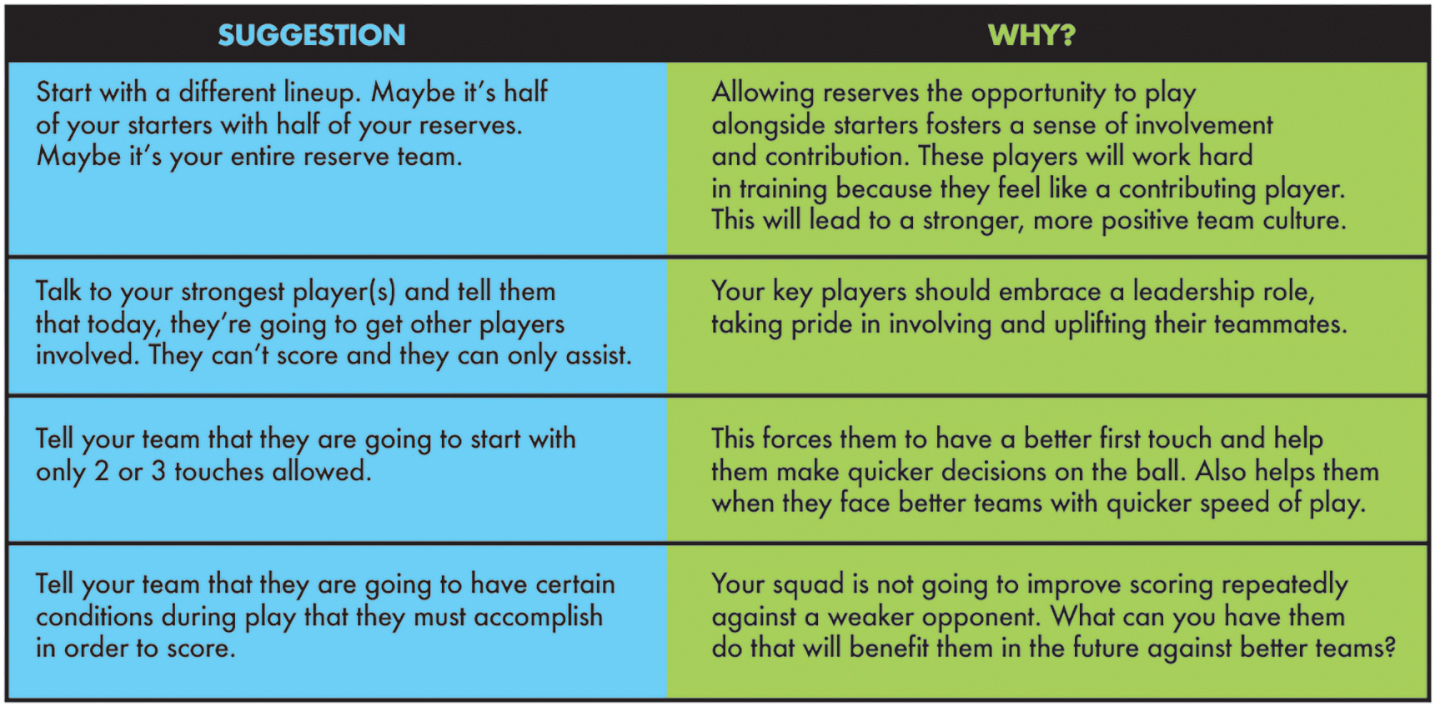
Sometimes you recognize soon after the whistle blows that you have the superior squad that day. Maybe you score a goal or two very quickly. Maybe you see that your team is technically and tactically superior and will control the match. As soon as you make the determination that you could easily win the game, you should be thinking about how you can tweak the game conditions to make it beneficial for both teams.  Some suggestions to make it more difficult for your team to score without taking away the ability to score include:

  • Making lineup changes sooner than later. Don’t wait until you’re up 5-0. It’s too late at that point.
  • Limiting the touches your players have on the ball. Make the players think and play quicker.
  • Having your team play the ball back to your goalkeeper after winning possession. Whether you win the ball back in the defensive, middle, or attacking third, the ball must be worked back to the goalkeeper before the team can go to goal. This forces your team to play back and then have to go the entire length of the field to score.
  • Having your team complete X number of combinations such as overlaps or give-and-gos before going to goal. Playing a weaker opponent gives us a good opportunity to rehearse some of these common patterns of play.
  • Giving the team a passing pattern they must complete before going to goal. Again, playing a weaker opponent gives us a good opportunity to rehearse some common patterns of play. Maybe you want them to work on playing balls into the feet of the target player, maybe you want them to work on playing through balls in behind the defense to the weak side midfielder, maybe it’s overlapping runs by the outside back followed by a cross into the box. Identify the area of the game your team needs to improve and create on-field scenarios that allow for targeted practice.
  • Only allowing attempts on goal from outside the box.
  • Only allowing attempts on goal with a player’s weaker foot.
  • Only allowing attempts on goal with a one-time finish.
  • Playing short on all restarts.

Removing players from the field of play (playing down) should be considered a last resort, only after all other efforts to maintain a competitive scoreline have been exhausted. Playing down can be perceived as disrespectful, and our goal is to keep all players on the field while challenging them to score under tough conditions. If despite the challenges your team continues to score easily, then it may be time to consider removing a player or more from the field of play. This document highlights the balance between competing to win and maintaining sportsmanship. While it’s crucial to aim for success, we must also ensure that we keep the game respectful for all involved, no matter what the score. As coaches, we set the tone for how our athletes approach the game, and it’s important that we instill values of respect, fairness, and integrity in every match.

With over 100,000 youth soccer players––both boys and girls––and more than 25,000 volunteers, the non-profit Eastern New York Youth Soccer Association (ENYYSA) stretches from Montauk Point, Long Island to the Canadian border. Members are affiliated with 10 leagues throughout the association, which covers the entire state of New York east of Route 81. ENYYSA exists to promote and enhance the game of soccer for children and teenagers between the ages of 5 and 19 years old, and to encourage the healthy development of youth players, coaches, referees and administrators. All levels of soccer are offered––from intramural, travel team and premier players as well as Children With Special Needs. No child who wants to play soccer is turned away. ENYYSA is a proud member of the United States Soccer Federation and US Youth Soccer. For more information, please log on to http://www.enysoccer.com/

Bumper Stickers, Myths, Rumors and Story Tellers

By Tim Bradbury, Director of Coaching, Eastern New York Youth Soccer Association

If this headline were the title of a new album by the Goo-Goo Dolls, I think we would rightly be excited and looking forward to the download date. 

Unfortunately, when it is the words that best describe the youth soccer environment that players and parents must wade through to find competitive games, all those who care about the future of the game should be concerned. 

I understand that most people want short cuts and that we live in a culture of “I want it now.” Having studied the works of Jean Piaget and read his description of the American issue, I understand that most of us are constantly searching for a way to get to number 1 by finding the best shortcut. Covid only seems to have placed an exclamation mark on the desperation to get great quick

My understanding of the issues has been extended after re-reading Bounce by Matthew Sayed. This brilliant book looks at the talent myth and presents a wonderful case using Tiger Woods, the Williams sisters, his own table tennis exploits as well as Mia Hamm and Messi to mention but a few. There has been much debate and discussion regarding the validity of the 10,000 hours rule. Through all the heated discussions, very few have doubted the fact that endless hours of intense and deliberate practice with the guidance of the right coach are required to fulfill your potential.

There should be no shortcuts, and really there are none, you must do the work and compete to play at a high level no matter what the bumper sticker on your car says.

One of the lasting issues of US Soccer’s decision to allow several governing bodies within the youth game has been the proliferation of Premier leagues. The number of coaches that have seized the chance to be able to say we are in a Premier league and we are therefore a Premier team is astounding. We need to be honest that just because it is called a Premier league does not necessarily make it one! If playing in the local league were a Division 3 team, you do not become Premier by simply moving to another league with the word Premier somewhere in the title. I hear you saying, “Tim, calm down, well what is the problem?” To make it plain and simple, as for myself the issue is clear, my problems with so many Premier leagues and the effects they are having are as follows:

1. Coaches and parents are jumping leagues simply to be able to say we are Premier. This impulsiveness misleads the players and encourages the shortcut culture. 

2. Players and parents jump from team to team looking for a real Premier team and so many of the positive social aspects of being on a team are lost.

3. By misleading our players with what is the real standard, we give them a false impression of how much real effort is needed to get to play at the highest level. 

4. By distributing the better players within each age group into so many different leagues, the overall standard is dropping. One key ingredient for high level soccer is that the most competitive players get to play together. 

5. One consequence of the confusion of what really is Premier becomes that teams play in multiple leagues. This drastic increase in the number of games played comes at the expense of less training. This hurts player development. It also lowers the standard of play in all the “Premier leagues” since the talent pool is now spread out across multiple leagues.

6. We are misleading our players. Coaching is a form of teaching, and I believe the old saying to be true that it is the most noble of professions. How can we lie to and mislead our players? I’m certain that the number of Premier leagues, select programs and academies will continue to grow, and the consequence of this expansion will continue to lower standards and disappoint players and parents.

The answer then, and the growth of the game, lies in the hands of the coaches and parents. I ask that you research and understand the issues stated above and that most importantly you stop chasing short cuts that are false.   

Tim Bradbury

Jean Piaget (French: [ʒɑ̃ pjaʒɛ]; 9 August 1896 – 16 September 1980) was a Swiss developmental psychologist and philosopher known for his epistemological studies with children. His theory of cognitive development and epistemological view are together called “genetic epistemology“.

Piaget placed great importance on the education of children. As the Director of the International Bureau of Education, he declared in 1934 that “only education is capable of saving our societies from possible collapse, whether violent, or gradual.”

Matthew Syed (born 2 November 1970) is a British journalist and broadcaster. He used to be an English table tennis international, and was the English number one for many years. He was three times the Men’s Singles Champion at the Commonwealth Table Tennis Championships (in 1997, 2000 and 2001), and also competed for Great Britain in two Olympic Games. Bounce: How Champions Are Made by Matthew Syed

« Previous Page
Next Page »
Eastern NY Youth Soccer Association
  • Contact Us
  • About ENYYSA
  • Member Leagues
  • Our Affiliates
  • Resources
  • Terms and Conditions
FOOTER LOGO
Privacy Policy
This website is powered by SportsEngine's Sports Relationship Management (SRM) software, and is owned and subject to the Eastern NY Youth Soccer Association privacy policy.
Powered by SportsEngine